Drehbuch / Screenplay
Otto Teufel
Vom APO-Aktivist zum Pflegefall
Tragikomödie & Sozialsatire
From APO-Activist to Nursing Case
Tragicomedy & Social Satire
Overview
Die Gesellschaft steuert auf eine Katastrophe zu. Jeder sieht sie. Keiner kann etwas dagegen unternehmen. Alle schauen weg. Sie hoffen, dass es nicht so schlimm werden wird. Doch es kommt viel schlimmer. Eine ganze Generation alternder Menschen steht Altersarmut und Vereinsamung bevor. Was kann die Lösung sein? Ist nicht ein Gefängnis das Gleiche wie ein Pflegeheim? Ist nicht Freiheit nur Illusion, bestenfalls eine Empfindung für Bewegung und Konsum, aber ohne Inklusion für Gedanken, da diese stets frei sind?
The society is heading toward a catastrophe. Everyone sees it. No one can do anything about it. Everyone looks away. They hope it won’t be as bad as it seems. But it will be much worse. An entire generation of aging people faces poverty and isolation in old age. What could be the solution? Isn’t a prison the same as a nursing home? Isn’t freedom just an illusion, at best a sensation of movement and consumption, but without inclusion for thoughts, since those are always free?
Storyline
Arm, alt, krank, was tun? Gefängnis statt Pflegeheim?
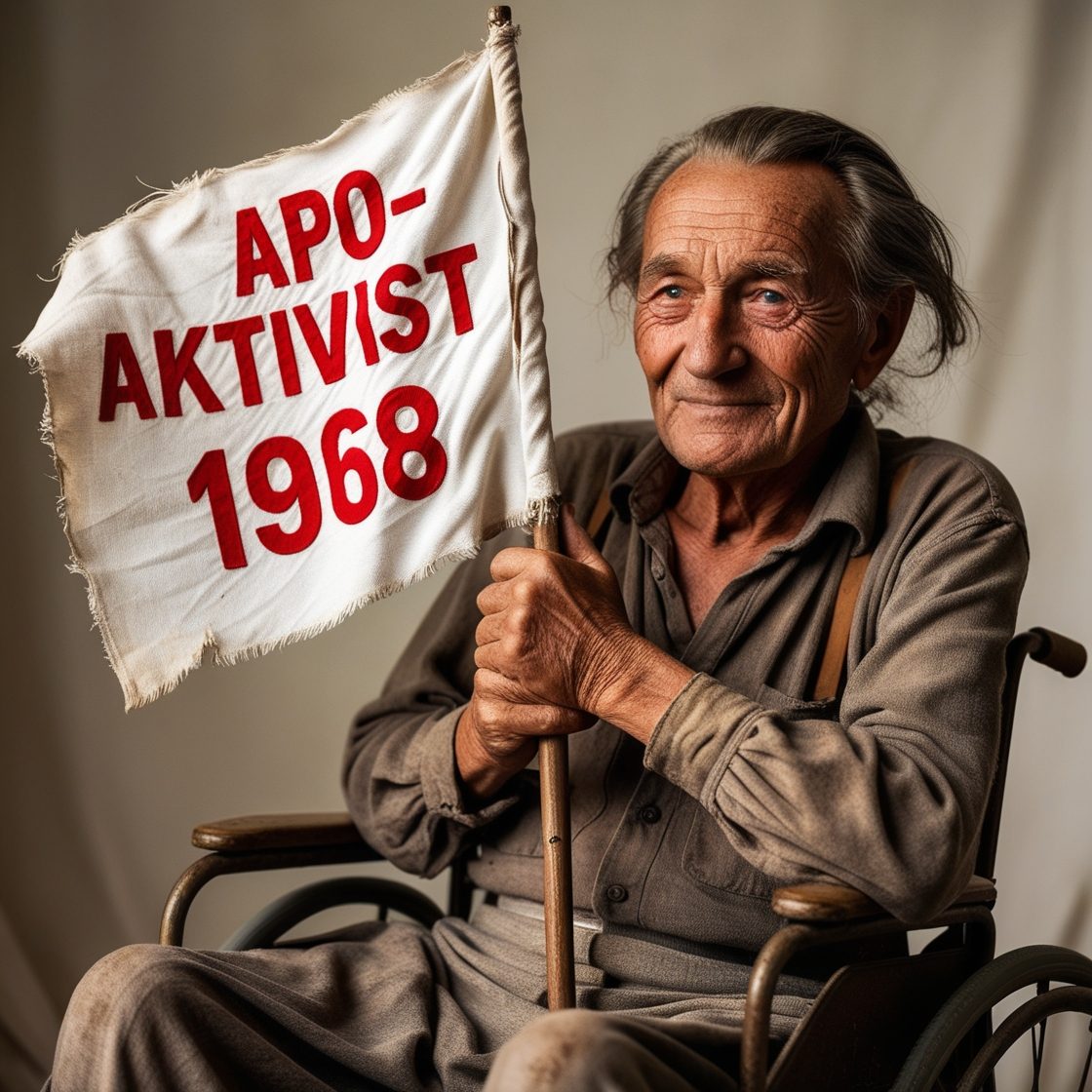
Otto Teufel, der jüngere Bruder von Fritz Teufel, geboren am 7. Juli 1945, ist wie Fritz ein Politaktivist der 68-Bewegung. Jedoch hat er es nie zu etwas gebracht, nicht einmal als Terrorist konnte er sich durchsetzen. Immer zu bekifft, hatte er stets verschlafen, wenn Anschläge geplant waren – er kam immer zu spät.
Von Bruder Fritz und von Rainer Langhans hatte er sich immer wieder Geld gepumpt, um seine drogeninspirierte Ablehnung der bürgerlichen Gesellschaft zu finanzieren. Seine Ablehnung war so radikal, dass er die Bewohner der Kommune 1 beklaut hatte, um an Marihuana zu kommen. Als sie ihn per Komitee-Beschluss aus der Kommune geworfen hatten, war seine Karriere als Politaktivist beendet. Von nun an war das Sozialamt für ihn zuständig.
Heute ist Otto 69 Jahre alt, Rentner und professioneller Kolleriger, der an Arthritis erkrankt ist. Er ist alleinstehend und vollkommen mittellos. Durch seine Krankheit ist er auf medizinische Betreuung angewiesen. Ihm steht ein siechendes Ende auf der Strasse bevor. Ein Pflegeheim, sei es auch noch so grauenvoll, kann sich Otto nicht leisten. Hingegen ist der humane Strafvollzug eine echte Alternative: Freie Kost und Lodgie, Einzelzimmer mit Fernseher, medizinische Versorgung und betreuter Hofgang.
Otto kommt auf den Gedanken, eine Bank überfallen zu wollen. Seine rationale Überlegung sind drei simple Optionen:
Option 1: Er kann mit dem Geld entkommen und hat von nun an ein sorgenfreies Leben.
Option 2: Er wird von der Polizei gefasst und kommt ins Gefängnis, wo ihm ebenfalls ein sorgenfreier Lebensabend bevorsteht.
Option 3: Er wird auf der Flucht von der Polizei erschossen. Dann wäre wenigstens sein qualvolles Leben beendet, der Tod wäre eine Erlösung.
Alle drei Optionen erscheinen Otto als wesentlich besser, als ein einsames und qualvolles Dahindämmern.
Doch es kommt ganz anders, als geplant: Die Bank, die Otto überfallen will, wird bei seinem Vorhaben von „echten“ Bankräubern überfallen. Otto kann diese Bankräuber austricksen, so dass die Polizei die Räuber überwältigen kann. Darüber hinaus kommt Otto unverhofft an die Beute der Bankräuber.
Auf dem Polizeirevier stellt Hauptkommissarin Otto zur Rede. Sie erkennt schnell, dass er nur ein hilfesuchender alter Mann ist und entwickelt Verständnis und Sympathie für ihn. Otto gesteht, dass er die Bank überfallen wollte, nur um nicht mehr dieses hilflose Leben führen zu müssen. Unverhofft kommt es zu einer philosophischen Auseinandersetzung über den Begriff Freiheit. Die meisten Menschen verbinden mit Freiheit vor allem Bewegungs- und Konsumfreiheit. Doch wenn man alt, krank und mittellos ist, haben Bewegungs- und Konsumfreiheit keine Bedeutung mehr.
Poor, old, sick - what to do? Prison instead of a nursing home?
Otto Teufel, the younger brother of Fritz Teufel, born on July 7, 1945, is, like Fritz, a political activist in the 1968 movement. However, he never achieved anything, not even as a terrorist he could make it. Always too stoned, he always overslept when attacks were planned - he was always too late.
He had repeatedly borrowed money from his brother Fritz and from Rainer Langhans to finance his drug-inspired rejection of bourgeois society. His rejection was so radical that he stole from the residents of Commune 1 to get marijuana. When they threw him out of the commune by committee decision, his career as a political activist was over. From then on, the social welfare office was responsible for him.
Today, Otto is 69 years old, a pensioner and professional nag who suffers from arthritis. He is single and completely destitute. Due to his illness, he is dependent on medical care. He faces a sickly end on the street. Otto cannot afford a nursing home, no matter how horrific it is. On the other hand, humane prison is a real alternative: free board and lodging, a single room with a television, medical care and supervised yard time.
Otto comes up with the idea of robbing a bank. His rational considerations are three simple options:
Option 1: He can escape with the money and from now on he will have a carefree life.
Option 2: He is caught by the police and sent to prison, where he also faces a carefree retirement.
Option 3: He is shot by the police while trying to escape. Then at least his painful life would be over, death would be a release.
All three options seem much better to Otto than a lonely and painful end to his life.
But things turn out completely differently than planned: the bank that Otto wants to rob is robbed by "real" bank robbers. Otto is able to outsmart these bank robbers so that the police can overpower the robbers. In addition, Otto unexpectedly gets hold of the bank robbers' loot. At the police station, Chief Inspector confronts Otto. She quickly realises that he is just an old man seeking help and develops understanding and sympathy for him. Otto admits that he wanted to rob the bank just so he wouldn't have to lead this helpless life anymore. Unexpectedly, a philosophical debate about the concept of freedom ensues. Most people associate freedom with freedom of movement and consumption. But when you are old, sick and penniless, freedom of movement and consumption no longer have any meaning.
Urheberrecht / Copyright
Alle aufgeführten Texte, Pitches, Exposés, Treatmens, Leseproben und Romane, sowie alle themenbezogenen Bilder sind nach §2 Abs.2 UrhG rechtlich geschützt und notarisch hinterlegt.
Drehbuchbezogene Texte dürfen nur zum privaten Gebrauch, oder zur Prüfung zwecks filmische Realisierung kostenfrei heruntergeladen und gelesen werden. Die private oder gewerbliche Vervielfältigung der Texte zur kommerziellen Verbreitung ist ausdrücklich untersagt.
Romanbezogene Texte dürfen nur zum privaten, nicht kommerziellen Gebrauch (oder Vergnügen) kostenfrei heruntergeladen und gelesen werden.
All listed texts, pitches, exposés, treatments, reading samples, and novels, as well as all related images, are legally protected under §2 para. 2 of the German Copyright Act (UrhG) and are officially notarized.
Screenplay-related texts may only be downloaded and read free of charge for private use or for evaluation purposes regarding potential cinematic realization. The private or commercial reproduction of these texts for commercial distribution is expressly prohibited.
Novel-related texts may only be downloaded and read free of charge for private, non-commercial use (or personal enjoyment).
Contact Agentur Screencreater
Phone: +49 171 4980909
E-Mail: agentur(at)screencreater.de